



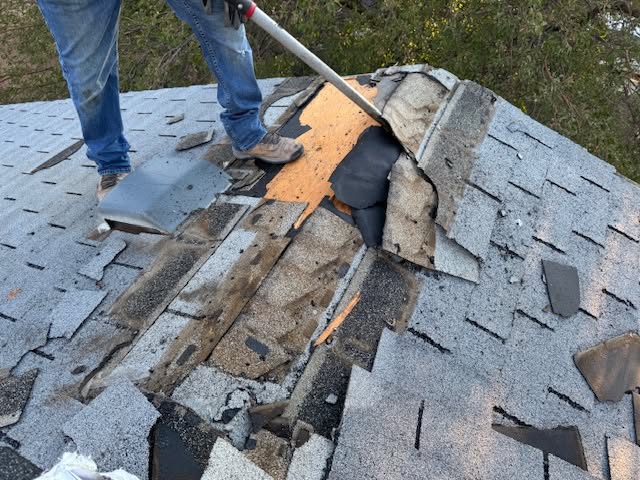
A hailstorm can roll through Loveland in twenty minutes and leave thousands of dollars in damage behind. The problem is you can’t always see it. Hail damage on a roof doesn’t look like a hole or a missing shingle, it looks like bruised asphalt and knocked-off granules that are invisible from the ground until the next rainstorm finds its way in.
What most homeowners don’t realize is that the decisions you make in the first 48 hours after a storm have a direct impact on your insurance settlement, and on whether you end up paying out of pocket for damage that should have been covered. Follow this checklist and you’ll be in the strongest possible position: documented, protected, and with a claim that actually reflects what your roof needs.
If hail just hit your home, here’s exactly what to do.
Table of Contents:
- Step 1: Stay Safe, Don’t Get on the Roof
- Step 2: Walk the Perimeter and Document Everything
- Step 3: Call a Roofer Before You Call Your Insurance Company
- Step 4: File Your Insurance Claim Promptly
- Step 5: Have Your Contractor at the Adjuster Meeting
- Step 6: Don’t Wait to Protect Exposed Areas
- Step 7: Watch Out for Storm Chasers
- Step 8: Get the Claim Reviewed If the Settlement Seems Low
✓ Step 1: Stay Safe, Don’t Get on the Roof
The first instinct is to go look. Don’t.
A wet roof after a storm is dangerous without proper equipment and training. And getting on the roof yourself can cause additional damage that complicates your insurance claim. Everything you need to assess right now can be done from the ground.
✓ Step 2: Walk the Perimeter and Document Everything
Once the storm has passed and it’s safe to be outside, walk around your home and photograph everything — ideally within a few hours of the storm. Time-stamped photos taken immediately after a storm are significantly stronger evidence than photos taken days later.
What to photograph outside:
- Missing, cracked, or visibly damaged shingles
- Dents on your gutters and downspouts
- Dents on your AC unit housing — if the AC is dented, your shingles almost certainly are too
- Any damaged window screens, siding, or trim
- Shingle granules in your gutters or downspouts — dark, sandy material washing out means shingles took hits
What to check inside:
- New water stains on ceilings or walls
- Moisture in the attic
- Anything that changed after the storm
✓ Step 3: Call a Roofer Before You Call Your Insurance Company
This is the step most homeowners get backwards.
When you file an insurance claim, your insurer sends their own adjuster to assess the damage. Whatever that adjuster finds becomes the baseline for your settlement. If you don’t have your own professional inspection documented first, you’re relying entirely on what the adjuster catches — and hail damage is notoriously easy to underestimate without trained eyes on the roof.
Schultz Roofing offers free hail damage inspections. Craig has been roofing in Northern Colorado since 1986 — he knows exactly what to look for, and he’ll give you a written damage report you can use when you file your claim.
Schedule your inspection before you file anything.
✓ Step 4: File Your Insurance Claim Promptly
Colorado insurance policies have filing windows. The longer you wait after a storm event, the easier it becomes for insurers to question whether damage is from that storm or from prior wear.
What to have ready when you file:
- Your policy number
- Photos and video taken right after the storm
- The written inspection report from your roofer
- The date and approximate time of the storm
Know your deductible. Some Colorado policies carry a separate wind and hail deductible that’s higher than your standard deductible. Know what yours says before you file.
Hard rule: No legitimate contractor will offer to waive your deductible. That’s insurance fraud in Colorado — the legal consequences fall on you, not the contractor. Walk away from anyone who offers this.
✓ Step 5: Have Your Contractor at the Adjuster Meeting
When your insurance adjuster comes to inspect the roof, have your roofing contractor there too.
Adjusters handle dozens of claims after a major storm and can miss subtle damage — bruised shingles, compromised flashing, areas of significant granule loss that require being on the roof to identify. A contractor who’s present during the adjuster visit can point out documented damage and make sure nothing legitimate gets left out of your settlement.
Craig Schultz has navigated hundreds of insurance claims for Loveland homeowners. He knows what adjusters look for and how to make sure the full scope of your damage gets properly documented.
✓ Step 6: Don’t Wait to Protect Exposed Areas
If the storm caused visible damage — missing sections, damaged flashing, or an area that’s clearly been breached — don’t wait for the insurance process to play out before protecting it.
Emergency tarping prevents water damage from compounding while your claim is being processed. Document any temporary protective work with photos and keep receipts — most Colorado policies cover reasonable temporary repair costs as part of the claim.
✓ Step 7: Watch Out for Storm Chasers
After a major hail event in Northern Colorado, out-of-area contractors show up fast. Door-to-door pitches, pressure to sign quickly, deals that sound too good.
Many of them won’t be around when warranty issues come up.
Before you hire anyone:
- Ask how long they’ve been operating in the Loveland and Fort Collins area
- Request proof of general liability insurance and workers’ compensation
- Check their Google reviews — from local Colorado homeowners
- Get everything in writing before signing or paying anything
Craig Schultz has been roofing in this community since 1986. He’s not going anywhere.
✓ Step 8: Get the Claim Reviewed If the Settlement Seems Low
The first insurance estimate isn’t always the final word.
If your contractor’s assessment and the adjuster’s estimate don’t match — if items are missing from the scope or the numbers don’t reflect current labor and material costs — you can file a supplemental claim. This is a standard part of the insurance process, not a dispute.
Schultz Roofing helps homeowners identify and document supplemental items when initial estimates fall short of what the restoration actually requires.
The Faster You Act, the More Options You Have
Getting an inspection scheduled quickly after a hail event gives you the clearest picture of what happened, the strongest position for an insurance claim, and the most options for how to move forward. Now you’re prepared for hail damage, whenever it hits. Stay safe, and refer back to this guide when you need to remember what to do!
Schultz Roofing serves Loveland, Fort Collins, Greeley, Windsor, Longmont, and surrounding Northern Colorado communities. Free inspections, honest assessments, and nearly 40 years of experience navigating exactly this situation.
Schedule your free hail damage inspection with Schultz Roofing →